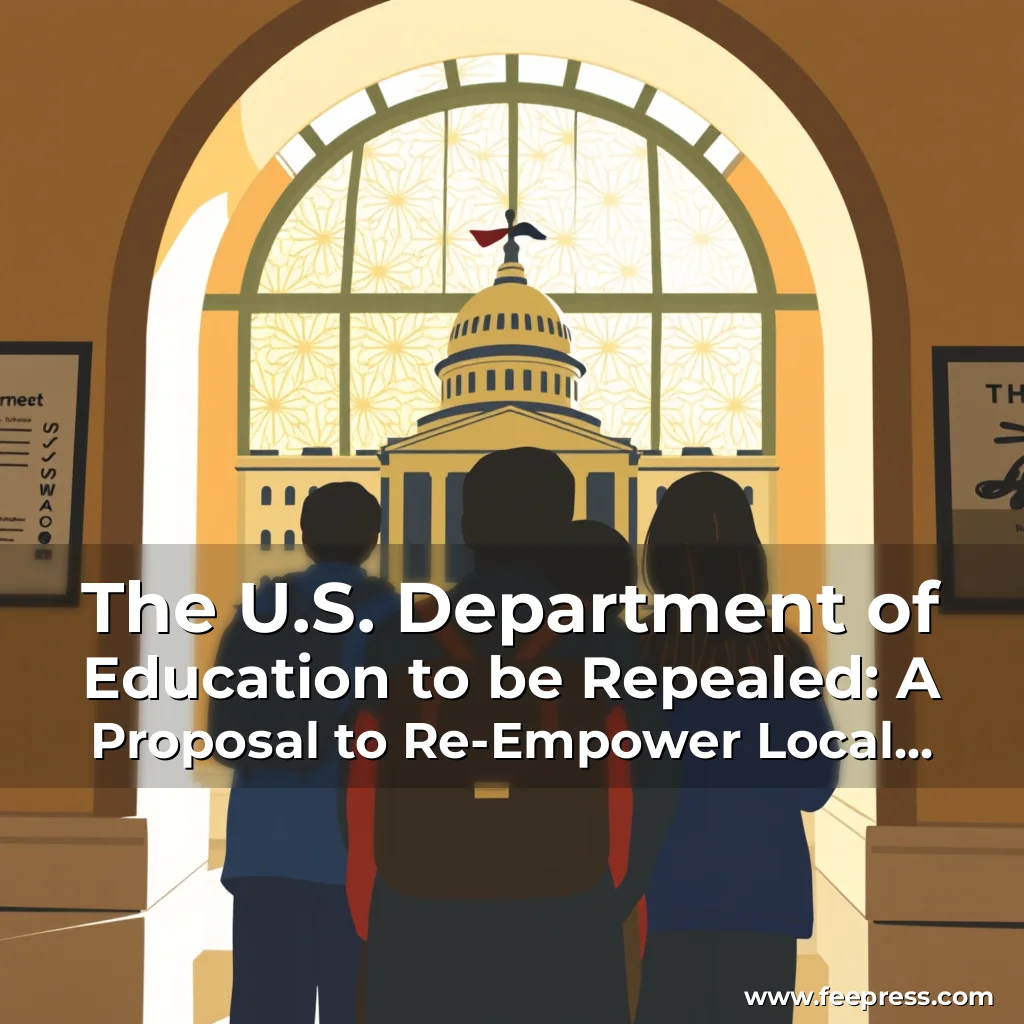
The U.S. Department of Education, a federal agency responsible for implementing and overseeing national education policy, has been a subject of controversy and debate. A proposal to repeal the Department of Education has been reintroduced by U.S. Senator Mike Rounds (R-S.D.), which aims to redistribute all critical federal programs to other departments and eliminate the agency’s bureaucracy. The Returning Education to Our States Act, as the proposal is called, is designed to ensure that education funding remains intact while eliminating the Department of Education’s administrative costs. The act does not aim to cut a single dollar of education funding, but instead, funds will continue to flow directly to states in the form of block grants. Other federal programs, such as those provided by the Department of Health and Human Services, will be funded through their respective agencies.
- By eliminating the Department of Education’s bureaucracy, the act aims to save approximately $2.2 billion per year in taxpayer dollars.
- The act also seeks to decentralize education decision-making, allowing states and local school boards to take a more active role in shaping education policies and standards.
- Furthermore, the act aims to reduce the influence of federal bureaucrats on education policy, allowing for more localized and responsive decision-making.
The proposal has received support from various stakeholders, including Senator Rounds, President Trump, Secretary McMahon, and the Manhattan Institute’s Senior Fellow, Christopher Rufo. “Since its inception, the Department of Education has grown into an oversized bureaucracy that dictates one-size-fits-all policies, standards, and practices for students across the nation,” said Senator Rounds. “By eliminating this bureaucracy, we can preserve important programs and federal funding while returning education decisions to the state and local levels where they belong.”
The Manhattan Institute’s Christopher Rufo highlighted the act’s potential to end the Department of Education’s corrupt ideological spoils system and return power to states, schools, and parents. “It’s time for action,” Rufo said. “Republicans have promised to abolish the Department of Education since it was created in 1979. President Trump and Senator Rounds are finally getting it done.”
Senator Rounds also pointed out that the Department of Education’s bureaucracy has led to a lack of accountability and transparency in education policy. “We all know that teachers, parents, local school boards, and state Departments of Education know what’s best for their students, not bureaucrats in Washington,” he said. Senator Banks of the American Federation of Teachers, stated “While the average Dept of Ed bureaucrat makes twice as much as a teacher in Indiana, our national test scores are near historic lows. That money should be sent back to the states to empower parents, teachers, and local leaders.”
Senator Sheehy, from the National Education Association, echoed this sentiment, saying “It’s time to put students first, not bureaucracy. We spend more on education than at any point in history, but test scores are declining because those dollars are being squandered by a bloated federal bureaucracy. Closing the DOE will not cut off funds from students who depend on them, but it will eliminate layers of red tape in Washington, D.C. and ensure taxpayer money for education is better spent at the local level, where the dollars support kids, families, and hardworking teachers.”
The Returning Education to Our States Act has the potential to revolutionize the way education is delivered in the United States. By decentralizing education decision-making and eliminating federal bureaucratic red tape, the act aims to empower parents, teachers, and local leaders to make decisions that are tailored to their specific needs.
| Benefits of the Act | Implementation |
|---|---|
| Preserves education funding | Continues to flow directly to states in the form of block grants |
| Eliminates bureaucratic red tape | Layers of red tape in Washington, D.C. are eliminated |
| Decentralizes education decision-making | States and local school boards take a more active role in shaping education policies and standards |
| Saves taxpayer dollars | Approximately $2.2 billion per year in taxpayer dollars are saved |
The Returning Education to Our States Act is a proposal that has the potential to transform the U.S. education system. By reducing the influence of federal bureaucrats and empowering local education leaders, the act aims to deliver more effective and responsive education policies. “While the average Dept of Ed bureaucrat makes twice as much as a teacher in Indiana, our national test scores are near historic lows,” said Senator Banks. “That money should be sent back to the states to empower parents, teachers, and local leaders. Congress has a golden opportunity to codify President Trump’s executive actions. This bill does that. It’s a win for American education.”
The act’s supporters argue that it is a necessary step towards putting students first, rather than bureaucrats. As Senator Sheehy put it, “It’s time to put students first, not bureaucracy. and ensure taxpayer money for education is better spent at the local level, where the dollars support kids, families, and hardworking teachers.”
“It’s time for action,” said Christopher Rufo, Senior Fellow at the Manhattan Institute. President Trump and Senator Rounds are finally getting it done. This legislation would end the Department of Education’s corrupt ideological spoils system and return power to states, schools, and parents. It’s time for action.”
The Returning Education to Our States Act has the potential to revolutionize the U.S. education system by putting students first and empowering local education leaders. By reducing the influence of federal bureaucrats and eliminating bureaucratic red tape, the act aims to deliver more effective and responsive education policies. As the act’s supporters argue, it is a necessary step towards putting students first, rather than bureaucrats.

news is a contributor at FeePress. We are committed to providing well-researched, accurate, and valuable content to our readers.