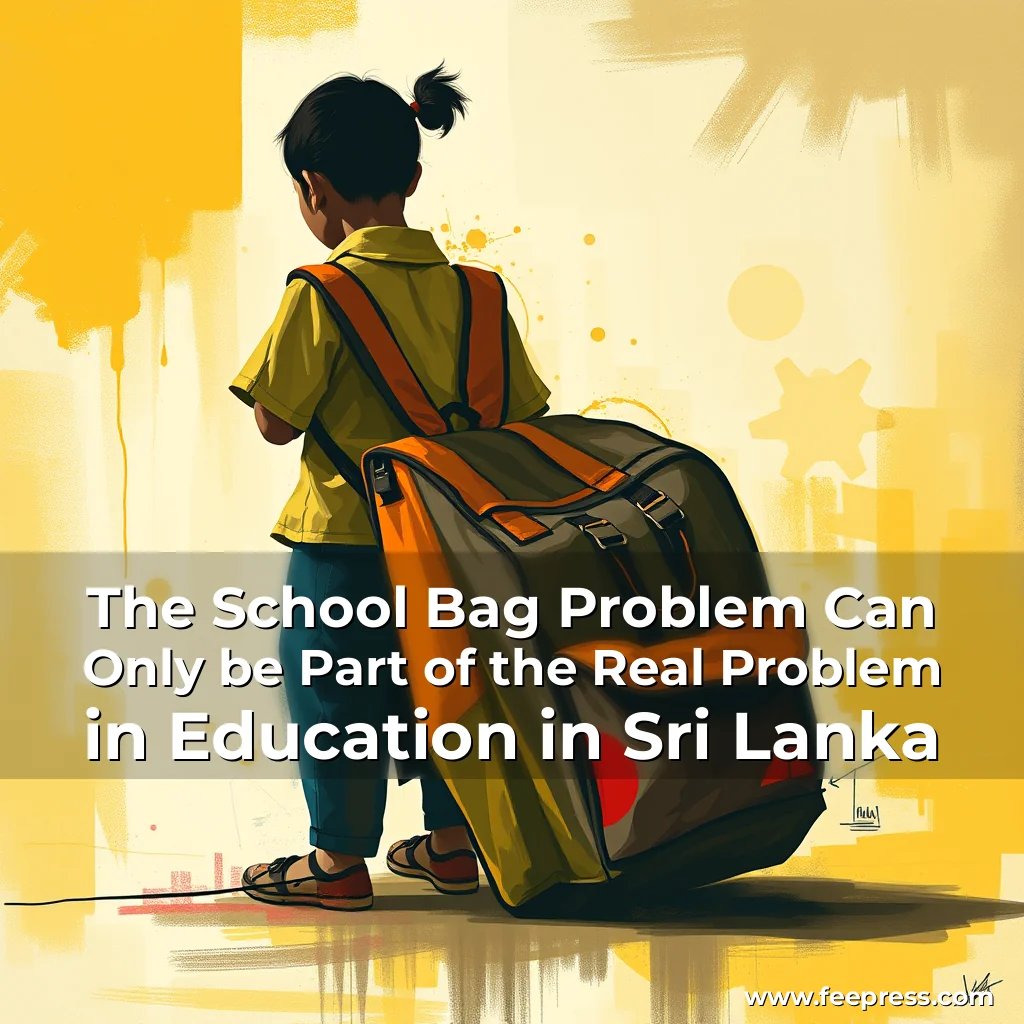
The school bag problem in Sri Lanka is a clear indication of the disaster of the education system. Most children in grades six to ten are forced to carry heavy school bags weighing up to 10 kilograms, posing a significant risk to their physical and mental health. This is not just a minor issue, but a symptom of a much larger problem in the education sector in Sri Lanka.
- One of the main issues is the lack of a comprehensive situational analysis of the education system, which is essential for identifying the root causes of the problems.
- The government and private schools/universities, curriculum, and quality of education are some of the key factors that need to be analyzed.
- Equity and inclusion, infrastructure and resources, governance and policy framework, teacher training and deployment, and labour market alignment are also important aspects to be considered.
In India, the Ministry of Human Resource Development (HRD) has prescribed a weight limit for school bags for each class, with the aim of reducing the burden on students. However, Sri Lanka has not yet taken similar measures to address the issue.
Need for a Comprehensive Education Reform
Sri Lanka needs a comprehensive education reform that addresses the various aspects of the education system. The country has failed to have a proper situational analysis of school education and university education, which is essential for identifying the root causes of the problems.
| Aspects of Education | Description |
| Government and private schools/universities and curriculum and quality | Analysis of the quality of education provided by government and private schools/universities, including the curriculum and teaching methods. |
| Equity and inclusion | Analysis of the disparities in educational opportunities among various socioeconomic, ethnic, and gender groups. |
| Infrastructure and resources | Analysis of the availability of infrastructure and resources, including libraries, laboratories, and sports facilities. |
| Governance and policy framework | Analysis of the governance structure and policy framework of the education sector. |
| Teacher training and deployment | Analysis of the training and deployment of teachers, including their qualifications and experience. |
| Analysis of the alignment of the education system with the labour market, including the skills and qualifications required by employers. |
The country needs to have a proper situational analysis to identify the root causes of the problems and develop effective solutions.
Learning from Other Countries
Sri Lanka can learn from other countries that have implemented effective education reforms. The World Bank’s “Systems Approach for Better Education Results” (SABER) initiative is a good example of this. SABER aims to produce comparative data and knowledge on education policies and institutions to help countries strengthen their education systems.
“We need to produce comparative data and knowledge on education policies and institutions to help countries strengthen their education systems.”
Sri Lanka can also benefit from other countries’ experiences in implementing education reforms. For example, the Indian government’s decision to prescribe weight limits for school bags for each class is a good example of a practical solution to a specific problem.
Dr. C.W.W. Kannangara’s Vision
Dr. Kannangara, the “Father of Education” in Sri Lanka, had a vision of free education for all citizens. He lobbied for 16 years before his plan became a reality in 1945. Kannangara’s vision is still relevant today, and Sri Lanka needs to consider implementing a comprehensive education reform that includes free education.
The Concept of a Graduate
The concept of a graduate has been debated in recent years. Reverend Weliwitiye Sri Soratha Thero, a renowned Buddhist scholar, defines a graduate as someone who has demonstrated intellectualism, creativity, and emotional intelligence. “It is our mission to present society with an intellectual, not merely to breed graduates. If one endeavours to transform this sacred abode into a place where degrees are sold, or one in which students are given degrees in a mere mechanical fashion, it will only lead the university as well as the country into disgrace.”
A graduate should not just have a high IQ but also demonstrate emotional intelligence and creativity. The concept of emotional intelligence is important in today’s business environment, where imagination and creativity are essential for success. The country needs to have a proper situational analysis to identify the root causes of the problems and develop effective solutions. Sri Lanka can learn from other countries’ experiences in implementing education reforms and consider implementing a comprehensive education reform that includes free education, as advocated by Dr. Kannangara. The concept of a graduate should be defined as someone who demonstrates intellectualism, creativity, and emotional intelligence.

news is a contributor at FeePress. We are committed to providing well-researched, accurate, and valuable content to our readers.